

|
|
|
|
|
|
A few tips for meditating on the Bible
For visitors to the website, Sadais.eu provides here a range of useful tips for meditating on the Word of God, the Bible.
For visitors to the website, Sadais.eu provides here a range of useful tips for meditating on the Word of God, the Bible.
A- Meditation in the life of a Christian
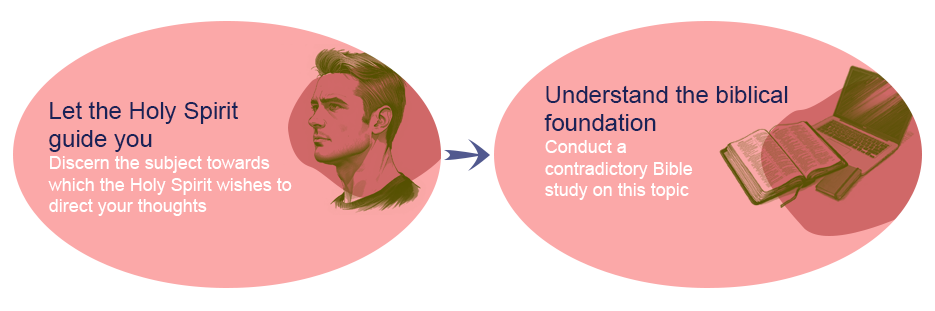
Meditate under the guidance and inspiration of the Holy Spirit
As a Christian, your spiritual growth is first and foremost the responsibility of the Holy Spirit, that zealous Teacher specially sent by the Father to instruct believers and remind them of Jesus’ teaching (John 14:26). Better and more surely than anyone else, the Holy Spirit knows in which areas your life as a believer needs to grow. He knows what path of growth you should follow. He Himself has set out the priority areas for you – those that will soon be useful to you in dealing with a situation that will arise, those that will enable your life to be ever more victorious, those that will set you free from your own prisons… He knows exactly how to help you progress, how to help you overcome your misunderstandings, your mental blocks, your resistance… In reality, all He needs is your attention.
When the Holy Spirit decides to help you grow in a particular area, He will often arrange circumstances to make you aware of that subject: a Bible passage you hear or read that leads you to consider the subject from a new angle – one that inspires you and does not leave you indifferent; an event that highlights it; a timely word from a brother, a sister or even a work colleague, etc. Seize all these opportunities that the Holy Spirit holds out to you, and allow yourself to be led in the direction He shows you: a blessing awaits you at the end of this path (Romans 8:28, 2 Peter 1:3).
Your meditation will therefore begin with an initial thought, inspired by these various circumstances: ‘What if God were trying to make me understand this?’, you will ask yourself. Your meditation can then begin.
From now on, it is up to you to judge, in the light of biblical teaching, the validity of this idea. You must therefore now examine what the Bible specifically teaches on this subject. Do not hesitate to undertake this critical analysis, for it demonstrates not a refusal to submit to divine instruction, but, quite the contrary, a desire to build your life upon the rock of divine revelation (Matthew 7:24–25, Galatians 1:9). Did not the apostle Paul ask the believers in Corinth, in 1 Corinthians 14:29, to judge for themselves the spiritual gifts that the Holy Spirit had bestowed upon them?
The first and most fundamental piece of advice from Sadais.eu is to always place your meditations under the guidance and inspiration of the Holy Spirit. Pray consistently with this in mind and learn to recognise what the Holy Spirit is showing you, just as Samuel had to learn to recognise the word that God was speaking to him (1 Samuel 3:1–10). You will then see how consistently the Holy Spirit works to help you grasp the teaching He wishes to impart to you, and to establish within you convictions that will enable you to move forward in peace and with confidence in your sanctification.
Identify the teachings of the Bible
You will need to identify the biblical teachings that you feel support the idea you are considering, but also – and this is important – those that you feel contradict it.
Sadais.eu suggests that you begin this exercise by listing the Bible passages that spring to mind; some may support this idea, whilst others may, at this stage (since the Bible does not contradict itself), appear to contradict it. If you only have a vague recollection of these passages and aren’t sure exactly where they are in the Bible, there are tools available today that can help you identify their references:
- Bible search engines by keyword: the reading websites listed by Sadais.eu generally offer this feature. Simply enter the words from the Bible passage that you can remember well enough to search the entire Bible or specific sections of it. Don’t forget to tell the search engine which translation you wish to use for your search,
- Conversational AI (artificial intelligence) systems whose training data includes the Bible: these tools will allow you to carry out searches, even if your memory of the Bible passage you are looking for is too vague to enable you to provide sufficiently precise keywords. They enable users to carry out thematic searches such as: ‘Which passage in the Old Testament describes a Jewish prophet foretelling what was being decided during the war councils of a foreign king?’ (Answer: the prophet Elisha concerning the king of Syria; 2 Kings 6:8–12).
- Consider these passages in the context of the biblical text that precedes and follows them. It may also be helpful to consider the historical period in which they were written, as well as the background of their author, their main characters and their original audience... A biblical dictionary can be very useful in this regard, as it provides this information in a concise and accessible way. Some Bible study websites or apps offer this type of dictionary,
- Please refer to the texts cited in these passages: for example, a quotation from the Mosaic Law or a reference to an earlier biblical event,
- Read different translations of these passages to ensure you do not misinterpret them. Many Bible study tools, particularly those available online, provide access to various translations, not only in English but also in other languages you may be familiar with.
Nowadays, the original Hebrew and Greek texts are also readily available. Consequently, Strong’s numbering system, developed before the computer age, remains a valuable tool even today for anyone who does not have a command of these languages. It enables users to identify the original word corresponding to each term in the KJV translation by providing a reference number that gives them access to its definition, its various meanings, its roots and its various occurrences in the original biblical text.
To gain an even deeper understanding of the original texts, do not hesitate to consult conversational AIs that have incorporated the Bible and these two languages into their training data. They can explain certain subtleties involved in translating biblical texts (be mindful, however, of the errors that AI systems may make: ask the AI you are using to justify its statements on points that are crucial to your reflection, or consult another AI system).
- Cross-references: many Bible study tools, particularly those available online, offer this feature, which links each Bible verse to other verses that share the same theme or idea. It is, in a sense, a vast mind map that connects all the Bible verses to one another through links of similarity or contrast. There is even a tool of this kind, originally designed for the KJV (King James Version) of the Bible, which allows users to select cross-references specific to certain parts of the verses being studied.
- Biblical commentary on the verses (bearing in mind that these commentaries obviously do not carry the same authority as the Bible),
- Conversational AI: these systems can respond to Bible search queries on the topics you specify.
It should be noted that these cross-references are also very useful for easily finding the biblical reference for a passage or event mentioned in a verse,
In this way, become people whose senses are exercised by reason of use, discerning both good and evil (Hebrews 5:14).
B- Meditation using the plans from Sadais.eu
It is this work of compiling biblical teachings—as described above—that Sadais.eu has carried out for the meditation topics it offers. It thus saves you time and enables you to begin your meditation with a relevant selection of biblical passages. Even though the meditation topics are predefined here, always seek the insight that the Holy Spirit may suggest to you whilst you meditate on these passages. Drawing on a particularly inspiring verse, He may lead you towards a line of thought slightly different from the one suggested by Sadais.eu. In that case, let yourself be guided and continue your meditation in the direction He points you; If you have enough time left after that, you can finish the meditation suggested by Sadais.eu later on.
In any case, do not regard the list of verses provided by Sadais.eu as exhaustive. On the contrary, please feel free to add to it as your own reflections take shape.
|
|
|
|
|
|


